

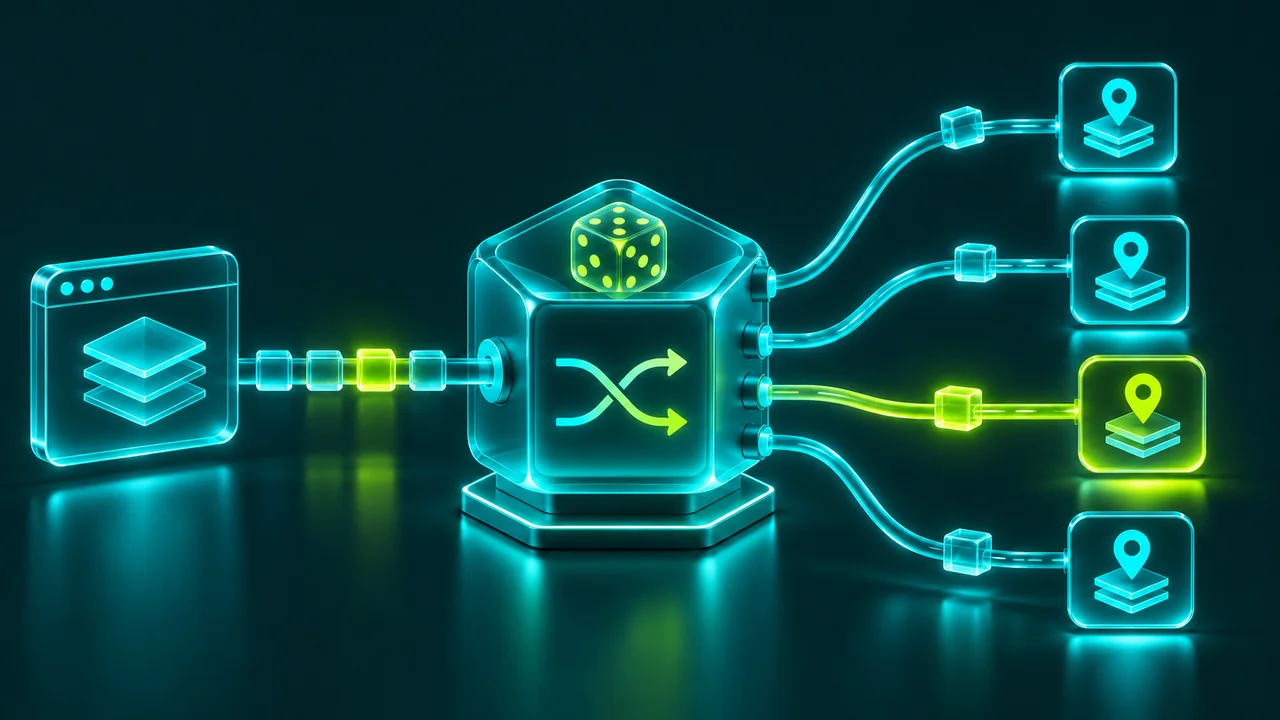
Same IP:port, a different egress per request
In VLSM.io Random IPv4 Proxy mode, the application connects to the same public IPv4 and port while each new request uses a different public outbound IPv4. The client does not need to consult a list of endpoints or modify its settings to trigger the change. This is the central difference from rotating mode: random changes follow every new request, whereas rotating changes follow a previously configured interval in minutes. In both modes, ingress and egress are separate points along the communication path between the application and destination.
A change between consecutive requests does not imply permanent address uniqueness. A previously used IPv4 may appear again later, after other egress addresses, depending on the available pool. That does not alter the requirement for each new request to use a different egress address from the preceding request. Tests should distinguish these two conditions. The product description concerns the per-call change policy; it does not claim that each address will be used only once throughout the entire lifetime of the operation or across all customers.
The public ingress IP and port remain the same across requests. The application retains this endpoint in its configuration; the proxy service changes the public outbound IPv4. Do not confuse this access address with the source observed by the destination. To validate the path, record the configured endpoint and actual egress, maintaining a correlation between task, timestamp, and result. This allows the team to prove that the change occurs on the outbound side without requiring repeated modifications to the client’s connection settings.
198.51.100.10:8080203.0.113.24One page can represent many requests
A page opened in a browser may load a main document, scripts, images, and data requests. A business operation may then span several pages and authenticated stages. The phrase one request therefore needs to be interpreted at the correct technical level. If a policy changes egress between related calls, the workflow must support that change. The service does not automatically recognize that several lookups belong to the same order, customer, or procedure performed by the bot.
Describe the unit of work before integrating. An independent query can work well with an egress change per request. A process requiring a constant source across steps should be assessed for another IP mode. Cookies, tokens, permissions, and the destination login session remain under application control regardless of the network policy. Separate these concepts in project requirements. A fixed proxy endpoint simplifies client configuration, but it does not make the outbound IPv4 fixed in random mode or automatically preserve a business session across calls.
HTTPS requires attention to tunnels and connections
With HTTPS through an HTTP proxy using CONNECT, the client establishes a tunnel and negotiates TLS with the destination. Later calls may use that same path. A proxy merely forwarding an encrypted tunnel does not automatically see each internal HTTP request in order to choose another egress address between them. Per-request selection therefore requires an explicit combination of client, service, and connection management support. Enabling an option named random is not enough to assume that result will occur.
HTTP/2 introduces another consideration: several exchanges can share one connection. Application request count can differ from the number of open connections. Document which event triggers selection in the contracted service and validate behavior with the protocol actually negotiated. This assessment does not require disabling TLS or inspecting private content. It requires understanding the transport path and checking egress in a controlled environment while preserving security guarantees and the application's functional behavior.
198.51.100.10:8080203.0.113.24198.51.100.10:8080203.0.113.78198.51.100.10:8080203.0.113.109Validate implementation, not just the endpoint
Integration must consider the library, version, connection reuse, and proxy configuration. Different tools can produce different behavior against the same endpoint because they organize transport and sessions differently. A single manual test does not necessarily represent an application maintaining an active connection pool. Reproduce the production client and conditions to confirm that the desired policy is observable without compromising task completion. The endpoint is only one component of the integration contract, rather than a complete explanation of its behavior.
If the service requires a specific method for selecting egress per request, follow the documented interface and confirm its scope. Do not improvise changes that turn every call into a new connection without assessing overhead, latency, and environment limits. The goal is functional compatibility, not merely visible address diversity. Record the approved configuration and retain a representative test for future library updates. Client changes may alter reuse or protocol negotiation and therefore affect observed behavior.
Design independent tasks with verifiable results
A random option can be evaluated for authorized lookups that do not require source continuity between calls. Each task should contain enough information to execute, validate, and record its result without relying on hidden context left by the previous task. This independence makes workload distribution and failure recovery easier. It also reduces the chance of associating different customers' data with the same session state because configuration was shared inappropriately across operations that should have remained separate.
Independence does not mean an absence of authentication or control. A query can use its own credentials while still respecting permissions, deadlines, and limits. Separate each task’s state and discard temporary information when it is no longer needed. For operations that modify data, preserve confirmation and duplicate prevention. If several calls require the same source, compare with a static egress or a rotating window suited to the project. Random mode keeps the configured ingress endpoint but changes the egress address between new requests.
Size communication costs and aggregate limits
A policy with frequent egress selection does not define total operating capacity. Concurrency, bandwidth, memory, and computing remain separate resources. Depending on the integration, new connections can add transport establishment and TLS negotiation to each task's duration. Measure this cost with the actual client. A configuration can increase the variety of observed addresses while reducing the amount of useful work delivered on time, particularly when the application spends more effort establishing communication than processing the requested information.
Plan workload by destination and across applications, not only by IP. Access conditions remain valid even when egress changes between lookups. Use queues to distribute permitted work and avoid unnecessary repeated calls. Track duration, transferred volume, and valid-result rate when comparing scenarios. The commercial objective should be sustainable task completion with predictable costs. Request count and the number of distinct addresses are supporting indicators, not a sufficient definition of productivity or the quality of an integration.
Observe fixed ingress and changing egress
A test should correlate the task identifier, transport event, and observed egress address. Keep the proxy IP and port constant and check that consecutive requests use different egress addresses. If two calls that should trigger rotation use the same IPv4, record the discrepancy and investigate the integration. A short sequence does not describe the entire pool distribution, but it can validate this specific requirement. Observing multiple addresses also does not prove that every internal request carried through a tunnel received a different egress address.
Keep testing against a controlled destination and also assess functional quality in the authorized workflow. Record errors by category while protecting credentials and sensitive data. Compare results with criteria defined before the pilot rather than adjusting expectations after seeing the numbers. If behavior differs, investigate the client, protocol, and service together. Observation should confirm a clear technical contract and identify limitations, not create a convincing-looking demonstration that fails to represent the real operation.
Choose the option with the workflow clearly defined
Before choosing Random IPv4 Proxy, describe the task, client, and protocol in use. Explain whether queries are independent or require source continuity. Confirm the public ingress IP and port that will remain configured, together with the method for observing public IPv4 egress. Define criteria for proving a different egress address for every new request and handling any discrepancies. This discussion distinguishes per-call changes, scheduled rotation in minutes, and a static source, helping teams choose the mode that suits the complete workflow and its operational requirements.
VLSM.io can support the compatibility assessment and choice of delivery method. A random option should be used as a connectivity policy within a well-structured application, without promises of anonymity, guaranteed unblocking, or unlimited capacity. When requirements, transport, and operations align, the company can assess its benefit clearly. The best project delivers the necessary behavior and correct results while preserving control over access, costs, state, and the continuing evolution of the integration as requirements change.
Institutional references
Reference documents on the topics covered in this article.